
The new NIGeL facilities are scheduled to open in April 2025 associated with the move of the Faculty of Science to the new Research Building at the Vrije Universiteit. Two laboratory suites are purpose-built to accommodate 1) a new all metal free clean laboratory for ultra-low blank sample handling and 2) a mass spectrometry laboratory for state-of-the-art isotope analyses.
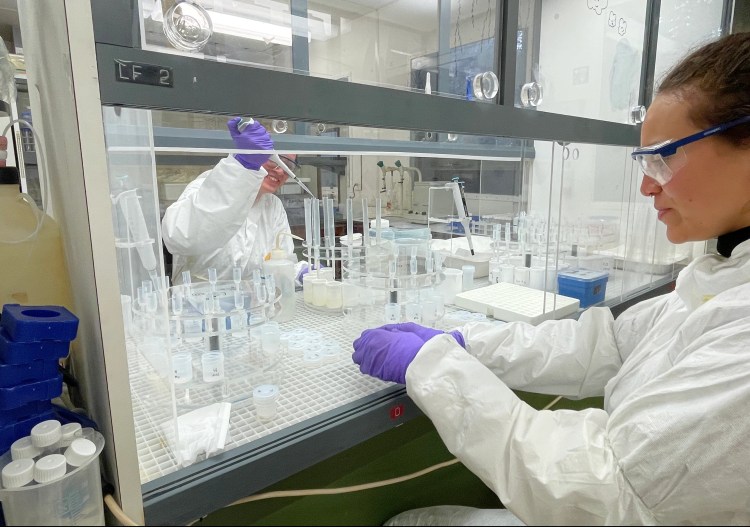
Clean Laboratory
The clean laboratory is used for low-blank sample preparation for isotope and trace element analyses of a variety of geological and archaeological materials. The HEPA-filtered clean room (ISO 4) is divided into a larger unit for processing of normal samples, acid distillation and lab ware cleaning and a smaller area for ultra-low-lab sample preparation (total procedure blanks <20 pg Sr, <1 pg Pb and Nd). Each unit will be equipped with multiple laminar flow workstations (ISO 3). The lab will additionally host a balance room with 4 analytical and microbalances.
All procedures are carried out with ultra-purewater (MilliQ®) and double sub-boiled Teflon distilled acids. Samples are digested either in Parr vessels under high pressure and temperature in Parr vessels or under low pressure in PFA vials on a hotplate. Elements are separated by liquid ion-exchange chromatography using various self-made PE or PFA columns for isotope analyses by MC-ICP-MS and/or TIMS.
The new clean laboratory is scheduled to be built in 2025.
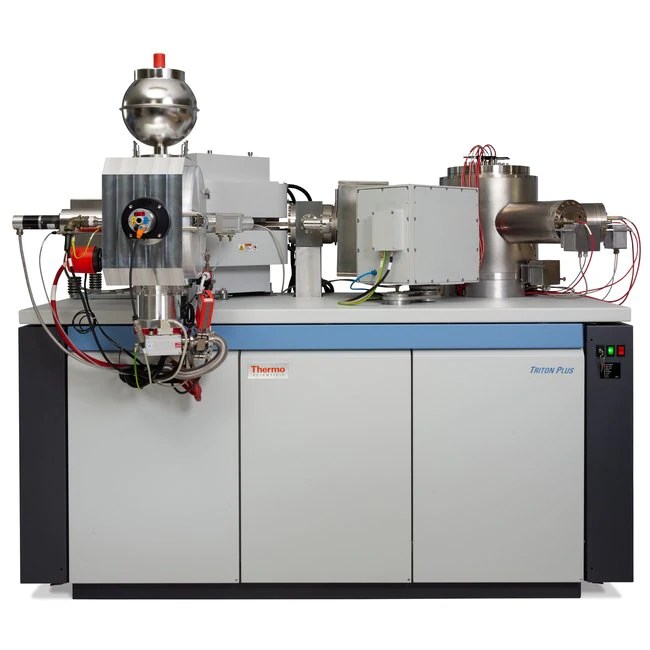
MC-TIMS Thermo Triton Plus
MC-TIMS and ICP instrument facility
There are two separate laboratories for Multi-Collector Thermal Ionisation Mass Spectrometry (MC-TIMS) and Multi- and single-Collector Inductively Coupled Plasma Mass Spectrometry ((MC)-ICPMS) analyses, separated by a control room with windows to each of the laboratories allowing remote monitoring of the instruments in a noise free environment.
MC-TIMS laboratory
The TIMS laboratory houses two MC-TIMS Thermo Scientific Triton Plus and Triton XT and a sample loading laminar flow hood. The Triton Plus has nine Faraday cups and a central SEM. The Faraday cups can be connected to 10 different amplifiers using a ‘Virtual Amplifier’ relay matrix. The amplifiers are equipped with two types of resistors; 1011 and 1013 Ω used for analysis of conventional and small beam sizes, respectively. The 1013 Ω resistors have 100 times higher signal output whereas they have relatively lower noise levels, resulting in increased precision when analysing small beams. We have six conventional 1011 Ω and four 1013 Ω amplifiers installed, and specialise in analysing Sr, Nd, Sm and Pb isotopes in small samples. The set-up, in combination with ultra-low blank chemical separation allow precise analyses of samples as small as 2 ng Sr, 30 pg Nd and 250 pg Pb. On the second Triton (XT), equipped with nine 1011 and one 1013 Ω amplifiers we routinely analyse the isotopic composition of larger amounts of Sr, Nd, Sm, Pb automatically.
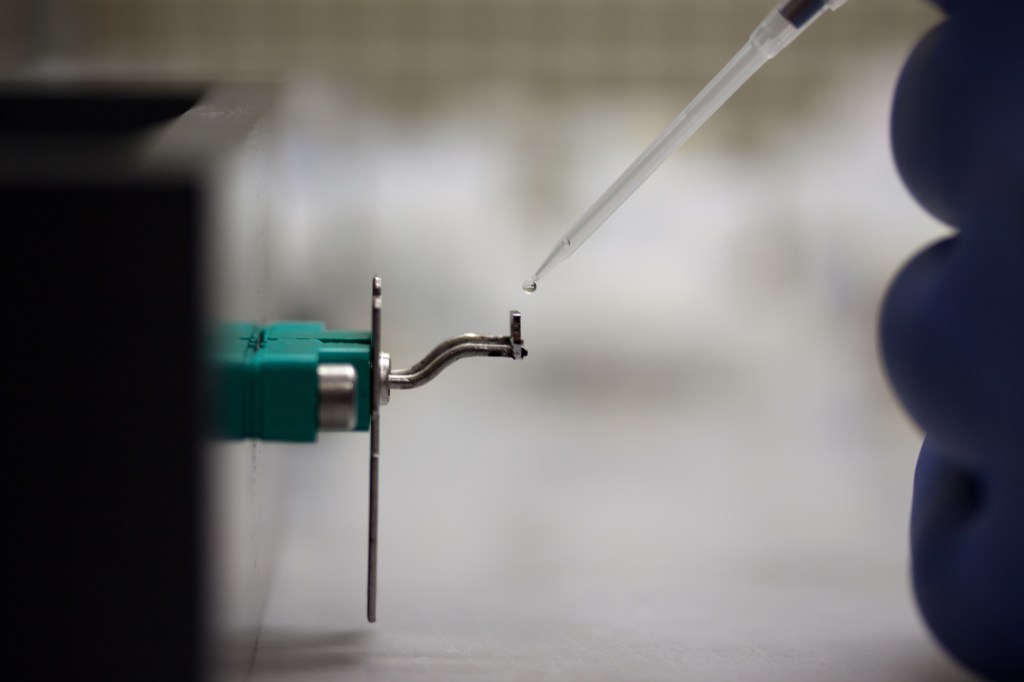
Loading of a sample onto a filament for MC-TIMS analyses
Inductively Coupled Plasma Laboratory
The plasma laboratory contains six instruments: two MC-ICPMS, a quadrupole ICP-MS, an ICP-OES and two laser-ablation systems.
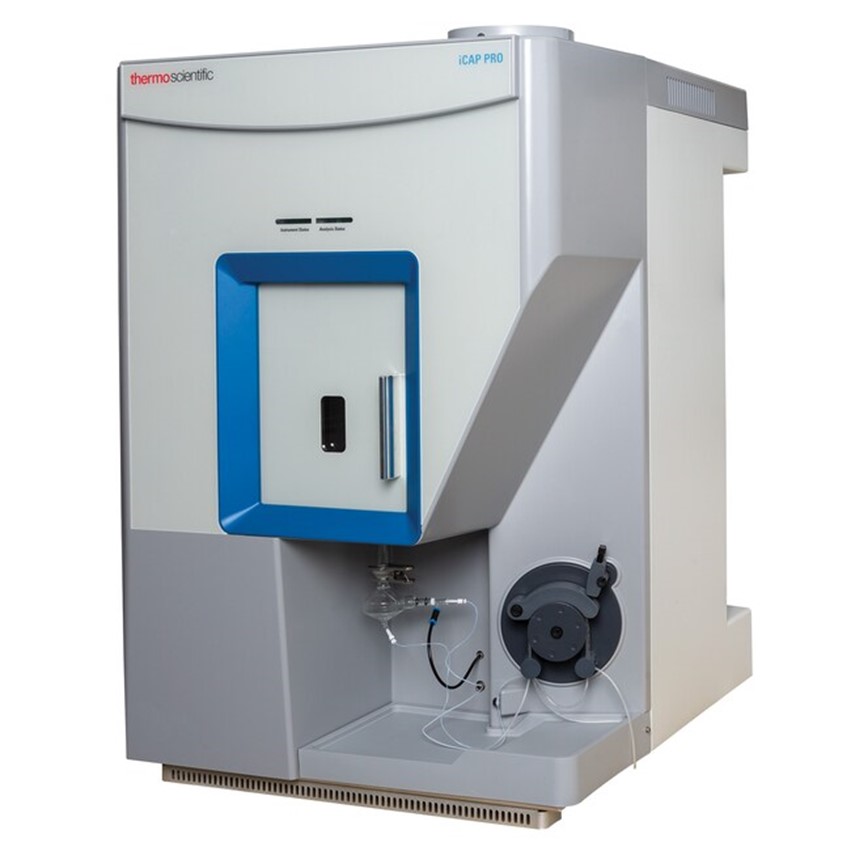
The optical ICP Thermo iCAP Pro
The optical ICP (inductively coupled plasma) is a modern compact, bench top Thermo iCAP Pro, with a verticalradial plasma view. This instrument will be used for major- and trace-element analysis of liquid samples (water, dissolved geological, archaeological, environmental, or forensic material). This instrument can also be connected to one of the laser-ablation instruments for major-element analysis of ablated solid materials. Limits of quantification are typically in the range of 0.05 to 10 ppb, depending on the element.
The ICP-MS instrument (Thermo iCAP-TQ) is an versatile instrument that can be used to analyze trace-elements in both solutions and solid material (laser-ablation). It contains two mass analysers on either side of a collision-reaction cell to separate masses from each other, resulting in interference free masses and therefore accurate measurements. In addition, it has a collision cell to remove interferences. In a collision cell gasses such as He, O2, and H are used to selectively collide of react with certain ions derived from the plasma or the sample matrix, separating the interference and target ions. Routinely, we analyse >40 elements from Li to U quasi-simultaneously in several minutes per sample. Samples are mainly introduced as solution via a quartz cyclonic spray chamber. The iCAP-TQ can also be attached to a femto-second or nano-second laser (see below) to analyse trace-elements in solid materials. Limits of quantification for liquid samples are generally, depending on the element, between 0.1 ppt and 0.1 ppb
The new standard Thermo Neoma MC-ICP-MS is equipped with 11 Faraday cups, which can be connected to eleven standard 1011 Ω and four 1013 Ω amplifiers. In addition, it is equipped with one electron multiplier. High resolution (mass resolving power up to ~12000) allows for resolving molecular isobaric interferences (e.g., 40Ar16O+ on 56Fe+). Samples are introduced as solution via a quartz dual cyclonic spray chamber (‘wet plasma’) or an Aridus III or Apex Omega desolvator (‘dry plasma’). In addition, the nano- and femto-second lasers can ablate solid metals and silicates and introduce them as aerosols to the plasma. We routinely analyse radiogenic isotopes (Rb/Sr, Sm/Nd,, Lu/Hf Pb, U/Th) as well as non-traditional stable isotopes (Li, Si, Fe, Cu, Zn, Sr, Ba).
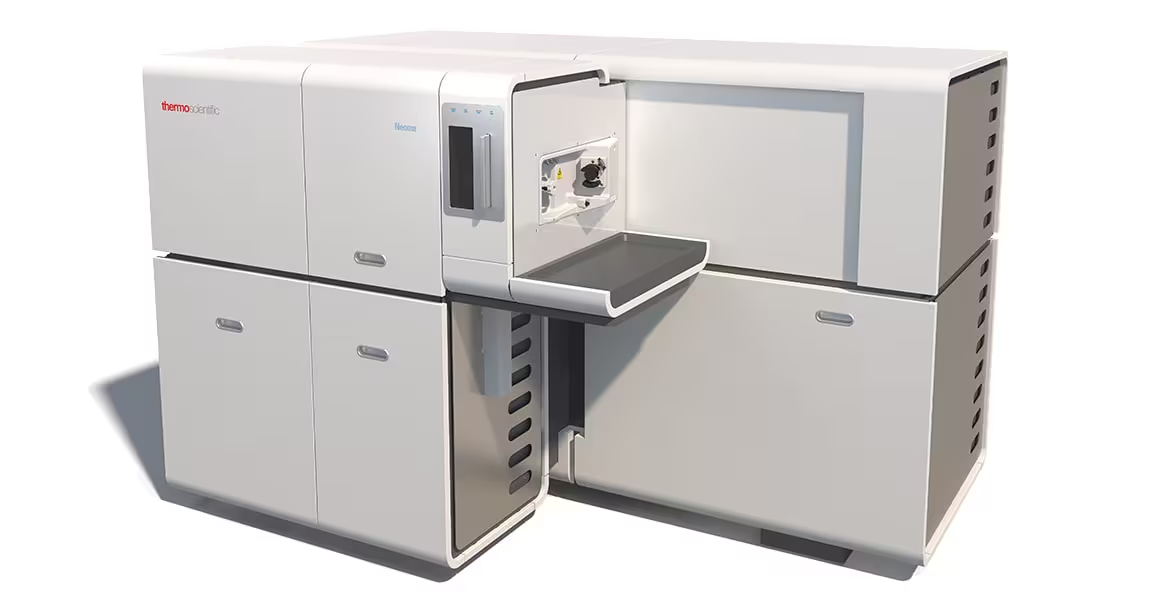
In addition to the standard Thermo Neoma instrument, we will also use a Neoma MS/MS. This instrument has the same setup as the normal Neoma, with the addition of an additional mass analyser (Wien filter) and collision-reaction cell before the magnetic sector. This configuration allows for the online separation of interferences which is important for the analysis of isotopes in situ by laser-ablation.
Four in situ analysis the lab will be equipped with two different laser ablation systems from Elemental Scientific Lasers (ESL): the imageGEO193 and the ESLfemto. Both of these instruments are equipped with modern two-volume ablation chambers for large sample sizes and fast washout times, and with high-precision motors for the stage. The imageGEO193 uses a 193 nm excimer laser. The ESLfemto uses a solid-state femtosecond laser, which may reduce the magnitude of laser-induced elemental and isotopic fractionation, particularly important for stable isotope analysis.

The current facility also includes innovative sampling devices such as a computer controlled microdrill and portable laser ablation.
 NIGeL Amsterdam